


A leaking water heater relief valve can mean that pressure is building up, the water is getting too hot, or the valve is no longer sealing properly. Sometimes the water isn’t coming through the valve at all: a nearby connection or the tank itself may be leaking. A drip doesn’t automatically mean you need a new water heater, but it should not be ignored.

First, keep clear of hot discharge. From a safe distance, note where the water appears and whether it drips or flows. These clues help a plumber diagnose the issue. This guide covers conventional tank-style water heaters.
Is a Leaking Water Heater Relief Valve Dangerous?
A leaking relief valve can signal excessive water pressure or temperature. A few drops are different from a forceful release of very hot water.
Keep people and pets away from the discharge pipe, especially if hot water is flowing. Water released by a relief valve can cause serious burns. If the discharge is substantial, extremely hot, or ongoing, obtain urgent qualified plumbing help. If overheating is suspected, follow the manufacturer’s emergency shutdown instructions to turn off the heater’s energy supply only if the shutoff is safely accessible and you know how to use it. Keep clear if you cannot safely reach or identify it, and do not resume operation until the cause has been assessed and corrected. Do not work on hot or pressurized fittings.
A few important rules apply to any suspected relief-valve problem:
- Never cap, plug, clamp, or obstruct the relief-valve discharge pipe. Blocking the pipe can defeat a critical temperature-and-pressure safety protection.
- Do not lift the valve’s test lever to troubleshoot an active leak. Hot water can discharge, and an aging valve may not reseal afterward. This does not replace scheduled maintenance: follow the heater and valve manufacturers’ periodic testing instructions, or have a qualified professional perform the test.
- Don’t assume drying the puddle fixes the problem. A recurring drip needs an explanation, even when the tank still heats water normally.
You only need to observe the problem safely, not diagnose it yourself.
How Can You Tell if You’re Looking at the Water Heater Relief Valve?
On many conventional tank water heaters, the temperature and pressure relief valve, often shortened to T&P valve or TPR valve, is a small metal fitting installed near the top or on the upper side of the tank. It commonly has a small test lever and a pipe attached to its outlet. That attached pipe is the discharge pipe: it directs water away when the valve opens.
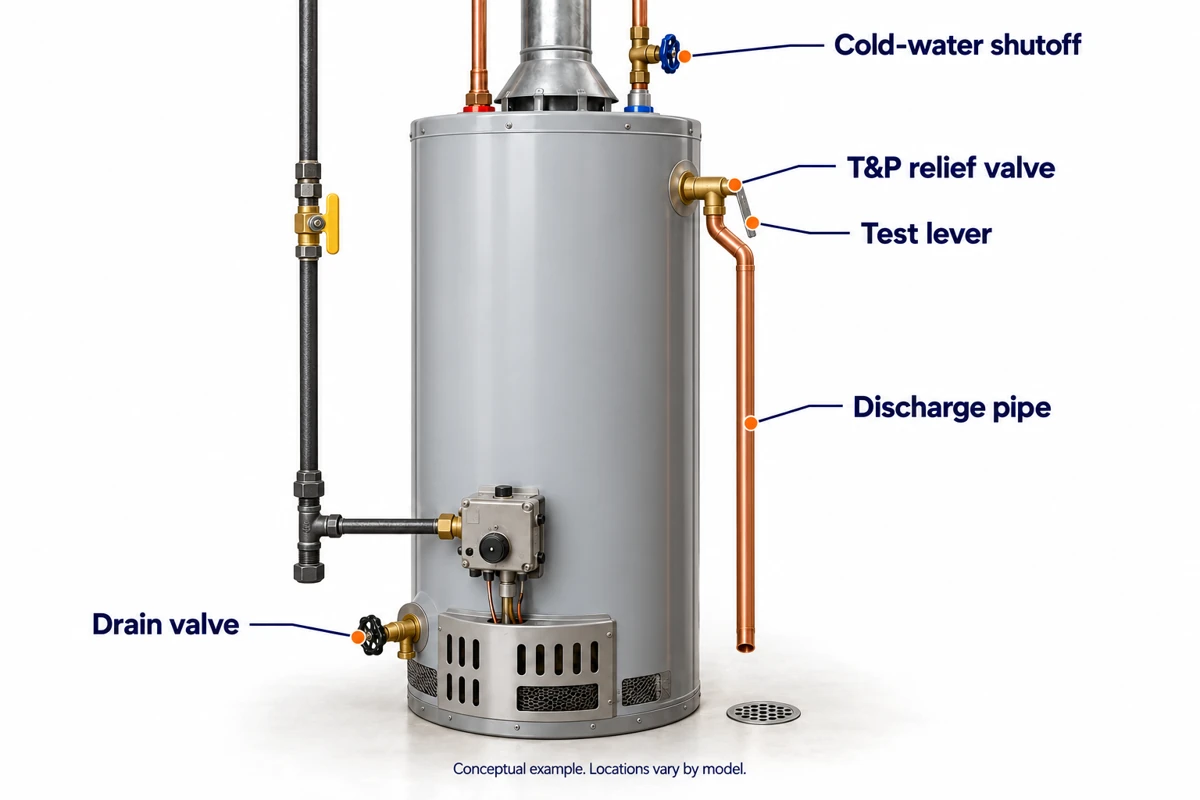
Look for the pipe leading away from that valve. Discharge-pipe routes and valve locations vary by heater model and installation.
The T&P valve is different from the cold-water shutoff and the drain valve near the tank’s bottom. If unsure, don’t operate anything; a photo from a safe distance may help your plumber.
The illustration identifies components; it is not an installation plan. Discharge piping must remain unobstructed, drain freely, and terminate at an approved location with the required air gap and clearances. A plumber should verify the heater instructions and applicable local requirements.
Where Is the Water Coming From: The Relief Valve or Somewhere Else?
Finding the leak’s starting point matters because water coming out of a relief valve’s discharge pipe is different from water escaping around the valve’s threads or another tank connection. A puddle under the water heater cannot, by itself, identify the failed part.
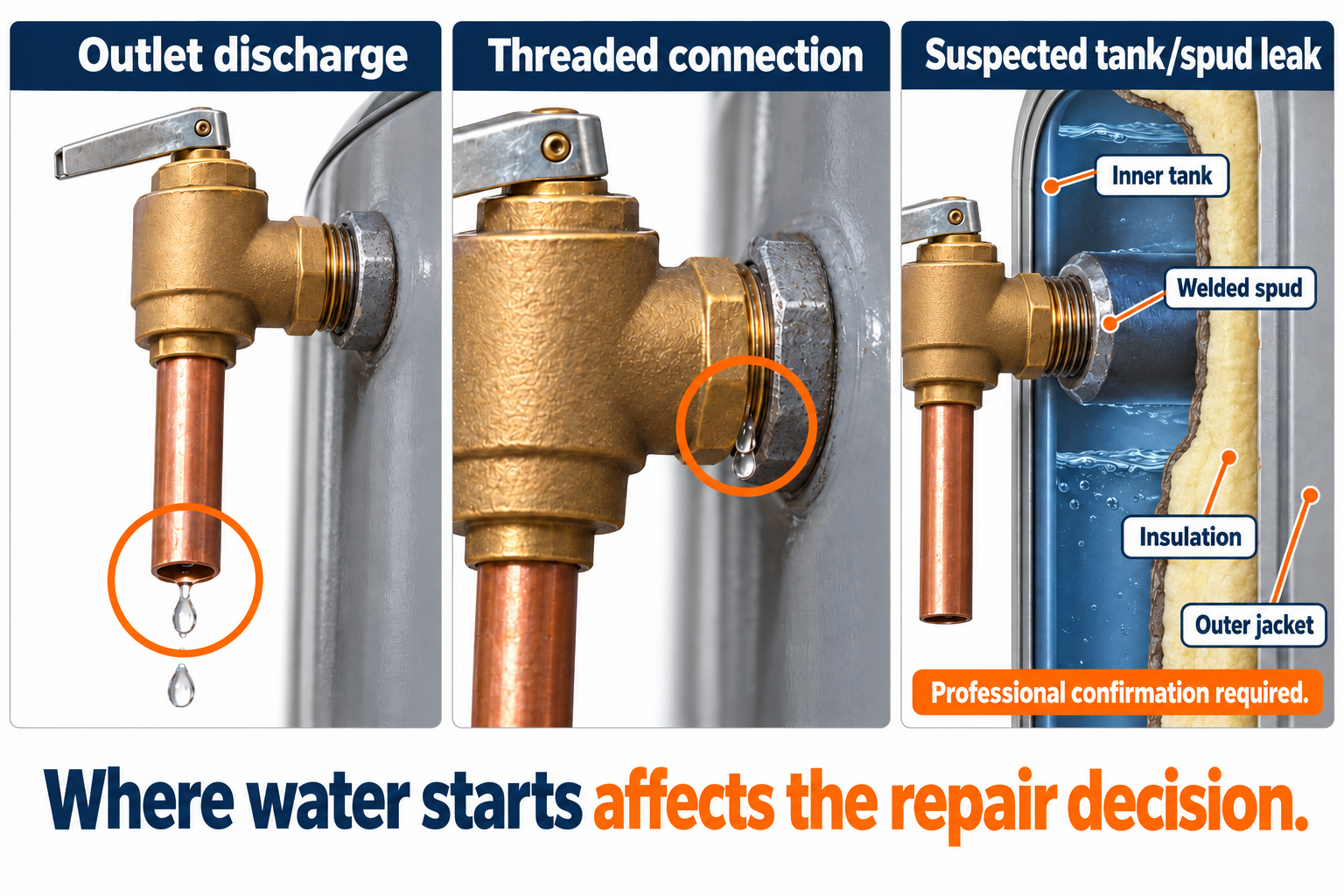
Without touching the heater or following water toward electrical or hot components, note what you can actually see:
| Where you notice water | What it may suggest | Sensible next step |
|---|---|---|
| At the end of the T&P discharge pipe | The water heater’s T&P relief valve may be opening from elevated pressure or temperature, or it may not be sealing completely. | Note whether flow is occasional or continuous and arrange an assessment. |
| Around the threaded valve-to-tank connection | The joint may be leaking even if the valve is not opening through its outlet. | Have a plumber inspect the connection; do not tighten a hot fitting yourself. |
| From piping, another fitting, or the lower drain valve | The moisture may be unrelated to the T&P valve. | Identify the general area safely and report it. |
| On the outer jacket or around the tank connection | Condensation, water traveling from another connection, or a tank leak may be involved. The outer jacket is separate from the inner water-holding tank; moisture on the jacket alone does not prove a welded-spud leak. | Request prompt inspection. A confirmed leak in the inner tank or its welded spud generally requires water-heater replacement. |
Water can travel along piping before dripping. A. O. Smith also identifies condensation, fittings, drain valves, and the tank as possible sources.
Does It Matter if the Relief Valve Drips Sometimes or Constantly?
Yes. The timing and amount of water leaving a relief valve can help narrow down the possibilities, although a drip pattern alone cannot confirm the cause.
A few drops that appear while the heater is reheating water may be associated with pressure increases caused by thermal expansion. Water that drips steadily, including when the heater hasn’t recently run, may point toward persistent pressure conditions or a valve that is not sealing completely. A sudden, substantial release of very hot water raises a more urgent concern about temperature control or pressure.
Never put your hand under the discharge pipe to test water temperature.
What Does Your Water Heater’s Relief Valve Actually Do?
The T&P relief valve is a safety device. It opens to release water when a water heater reaches the valve’s specified temperature or pressure limit. A T&P valve can therefore discharge water while functioning correctly, even though the cause still needs attention.
Many residential T&P valves are rated at 150 pounds per square inch (PSI) and 210°F, as described in A. O. Smith’s technical guidance and a Watts valve specification. The correct rating depends on the particular heater and valve; these numbers are not universal.
A T&P valve is not meant to manage routine thermal expansion. Repeated discharge needs investigation, even when the valve is opening as designed.
Why Does a Water Heater Relief Valve Start Leaking?
The main question is whether the T&P valve is opening in response to conditions inside the heater or leaking because it no longer seals. A threaded connection can leak separately. Those possibilities call for different repairs, so replacing the valve without identifying the cause may not solve the problem.
Why Does the Relief Valve Drip When Your Water Heater Heats Up?
Thermal expansion means that water takes up slightly more space as it gets hotter. In a closed plumbing system, a check valve, backflow preventer, or certain pressure-reducing valves can prevent expanded water from pushing back into the public supply. With nowhere for that extra volume to go, pressure can rise while the heater warms the water.
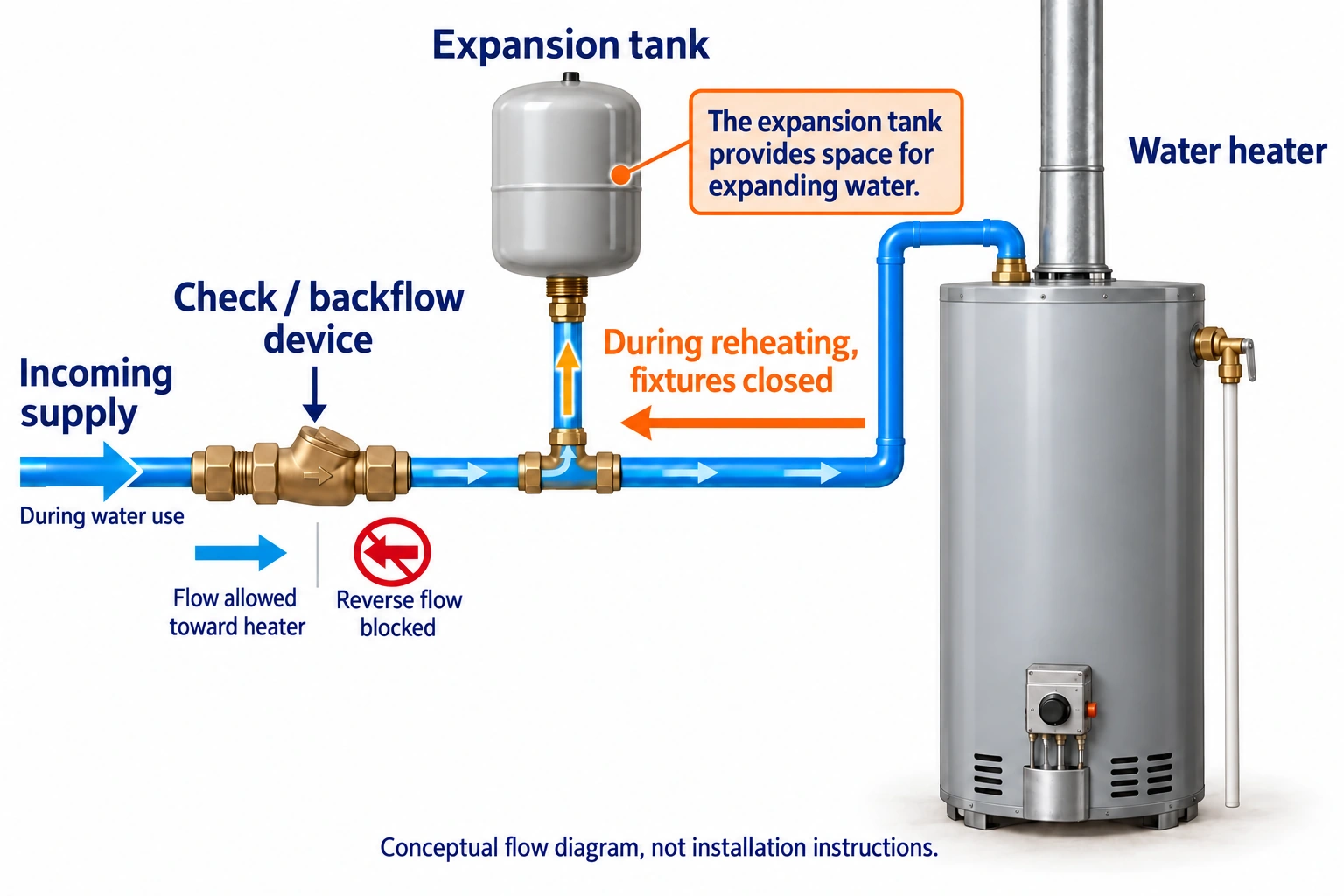
In a closed plumbing system, thermal expansion may cause the water heater’s T&P relief valve to drip during or after reheating, especially when no fixtures are running. The pressure has to rise enough to activate the valve; the timing alone does not prove thermal expansion is responsible.
A properly sized and functioning thermal expansion tank provides a place for expanding water to go. A plumber can check expansion control and any existing expansion tank. See A. O. Smith’s thermal expansion bulletin.
Can High Water Pressure Make the Relief Valve Leak?
Yes. High incoming water pressure can contribute to excessive pressure in a water-heating system, especially when thermal expansion increases pressure further during heating cycles.
Under 2025 California Plumbing Code §608.2, static water supply pressure above 80 PSI calls for approved pressure regulation. A pressure-reducing valve (PRV) may be part of the solution. But 80 PSI is not the opening setting of a typical 150-PSI-rated water-heater relief valve. A single high supply-pressure reading cannot, by itself, explain why that safety valve is discharging.
A plumber may compare incoming pressure with pressure during the heater’s recovery cycle, then inspect the regulator and any expansion-control components. For broader household pressure questions, see Discount Plumbing’s guide to ideal house water pressure.
Can an Overheating Water Heater Trigger the Relief Valve?
Yes. Excessive water temperature can cause a T&P valve to open, because the valve is designed to respond to both temperature and pressure. A malfunctioning thermostat or other temperature-control problem can allow the tank’s water to become hotter than intended.

An unusually hot water supply or a large release of very hot water may be a sign of overheating. A large release of unusually hot water from the T&P discharge pipe warrants urgent professional attention because it creates a scalding hazard and may indicate a temperature-control fault. If overheating is suspected, follow the manufacturer’s emergency shutdown instructions to turn off the heater’s energy supply only if the shutoff is safely accessible and you know how to use it. If you cannot safely reach or identify it, keep clear and obtain urgent professional help. Do not resume operation until the cause has been assessed and corrected. A temporary stop in the discharge does not confirm the underlying issue is resolved. See A. O. Smith’s relief-valve bulletin.
Don’t touch the discharge pipe, pull the lever, or adjust unfamiliar controls to test for overheating.
Could a Worn-Out or Dirty Relief Valve Be the Problem?
Yes. Wear, mineral particles, or debris around the valve seat may stop a T&P relief valve from closing tightly. The valve seat is the internal surface that forms the seal when the valve shuts. If that seal is imperfect, water may continue to drip even after pressure or temperature returns to normal.

A valve may also leak after opening and failing to reseal. Do not lift the lever to troubleshoot an active leak. Follow the manufacturer’s separate periodic maintenance and testing instructions, or have a qualified professional perform the test.
Replacing the valve without checking pressure and temperature can miss the problem. Even a new valve may drip if excessive system pressure remains.
How Will a Plumber Figure Out Why Your Relief Valve Is Leaking?
A professional diagnosis begins with the source of the water, not an assumption that the relief valve has failed. The goal is to distinguish a valve opening due to system conditions from a connection leak or a valve that no longer seals.
Depending on the installation, a plumber may:
- Identify the source. Check whether water exits the T&P outlet, leaks around threads, or comes from another fitting or the tank.
- Check pressure behavior. Evaluate whether the system has elevated supply pressure or a pressure increase during heating.
- Evaluate temperature controls. Check for evidence of overheating and control problems according to the heater’s instructions.
- Inspect components. Assess the relief valve and rating, discharge piping, regulator, and any expansion tank.
- Explain the likely fix. Match the remedy to the valve, connection, pressure control, heater controls, or tank condition.
Testing depends on the equipment and symptoms.
What Do Water Pressure and Temperature Tests Tell the Plumber?
A rise in system pressure while a tank water heater reheats, despite relatively stable incoming supply pressure, can support a diagnosis of thermal expansion in a closed plumbing system. High pressure even before heating may instead direct attention toward the supply and its pressure regulator. Neither pattern, on its own, proves a valve failure.
Temperature findings may indicate overheating. The plumber also considers discharge location and timing, valve rating, and heater controls.
Does a Leaking Relief Valve Mean You Need a New Water Heater?
No. A leaking water heater relief valve does not automatically mean the entire water heater needs replacement. If the tank is sound, a plumber may be able to correct the issue by addressing a faulty valve, a leaking connection, a pressure-regulation problem, or inadequate thermal-expansion control.
A confirmed leak in the tank itself or its welded spud generally requires water-heater replacement. The spud is the fitting welded to the inner water-holding tank, not the outer jacket. Water visible on the jacket alone does not prove that the tank has failed. The distinction can be specific: A. O. Smith notes that a leaking threaded relief-valve connection may be resealed by a professional, while a confirmed leak at the fitting welded to the tank requires replacing the heater. A water heater’s age alone does not establish that its tank has failed.
A useful question to ask is: “Is the water coming through the relief valve, around its connection, or from the tank?” The answer affects both the repair plan and the cost. Ask the technician to explain the findings before deciding on a new heater.
If replacement is recommended, ask what evidence supports it and whether repair remains a safe option.
Need Help With a Leaking Water Heater in San Francisco? Contact Discount Plumbing
If your water heater’s relief valve is dripping or releasing water, Discount Plumbing offers water heater repair and diagnosis in San Francisco, including pressure-relief valve concerns. The right fix starts with identifying where the water begins and whether pressure, temperature, the valve seal, or the tank is involved.
To request an assessment, call (415) 702-1079 or use the company’s contact and scheduling page. When you contact the team, describe where the water appears, whether it drips or flows, and whether it seems unusually hot. That information can help guide the next step without requiring you to touch the equipment.
Quick answers to common relief-valve questions
A leaking relief valve can signal excessive water pressure or temperature. A few drops are different from a forceful release of very hot water.
Yes. The timing and amount of water leaving a relief valve can help narrow down the possibilities, although a drip pattern alone cannot confirm the cause.
Yes. High incoming water pressure can contribute to excessive pressure in a water-heating system, especially when thermal expansion increases pressure further during heating cycles.
Yes. Excessive water temperature can cause a T&P valve to open, because the valve is designed to respond to both temperature and pressure. A malfunctioning thermostat or other temperature-control problem can allow the tank’s water to become hotter than intended.
Yes. Wear, mineral particles, or debris around the valve seat may stop a T&P relief valve from closing tightly. The valve seat is the internal surface that forms the seal when the valve shuts. If that seal is imperfect, water may continue to drip even after pressure or temperature returns to normal.
No. A leaking water heater relief valve does not automatically mean the entire water heater needs replacement. If the tank is sound, a plumber may be able to correct the issue by addressing a faulty valve, a leaking connection, a pressure-regulation problem, or inadequate thermal-expansion control.

